Software and licensing for EMIs and payment institutions

EMI software you configure and run yourself. We obtain the licence.

Under your own licence, a partner EMI's, or white-label. Your team changes currencies, tariffs and approval rules without asking us.

  • Running today: IBAN accounts in EUR, USD, GBP, CAD; SEPA Instant; virtual cards; FX; KYC and AML; back office.
  • You configure: Settings in the back office or config, languages as dictionaries, one Docker Compose file.
  • The licence: Partner EMI's agent in 2 months, or your own licence or registration in 22 jurisdictions.
Get a proposal

Test money only. Ask us for a login; we open the back office to your IP.

Home screen of the demo customer app: total balance across currencies, accounts with IBANs, recent transactions and a virtual card. Test data.Home screen of the demo customer app: total balance across currencies, accounts with IBANs, recent transactions and a virtual card. Test data.
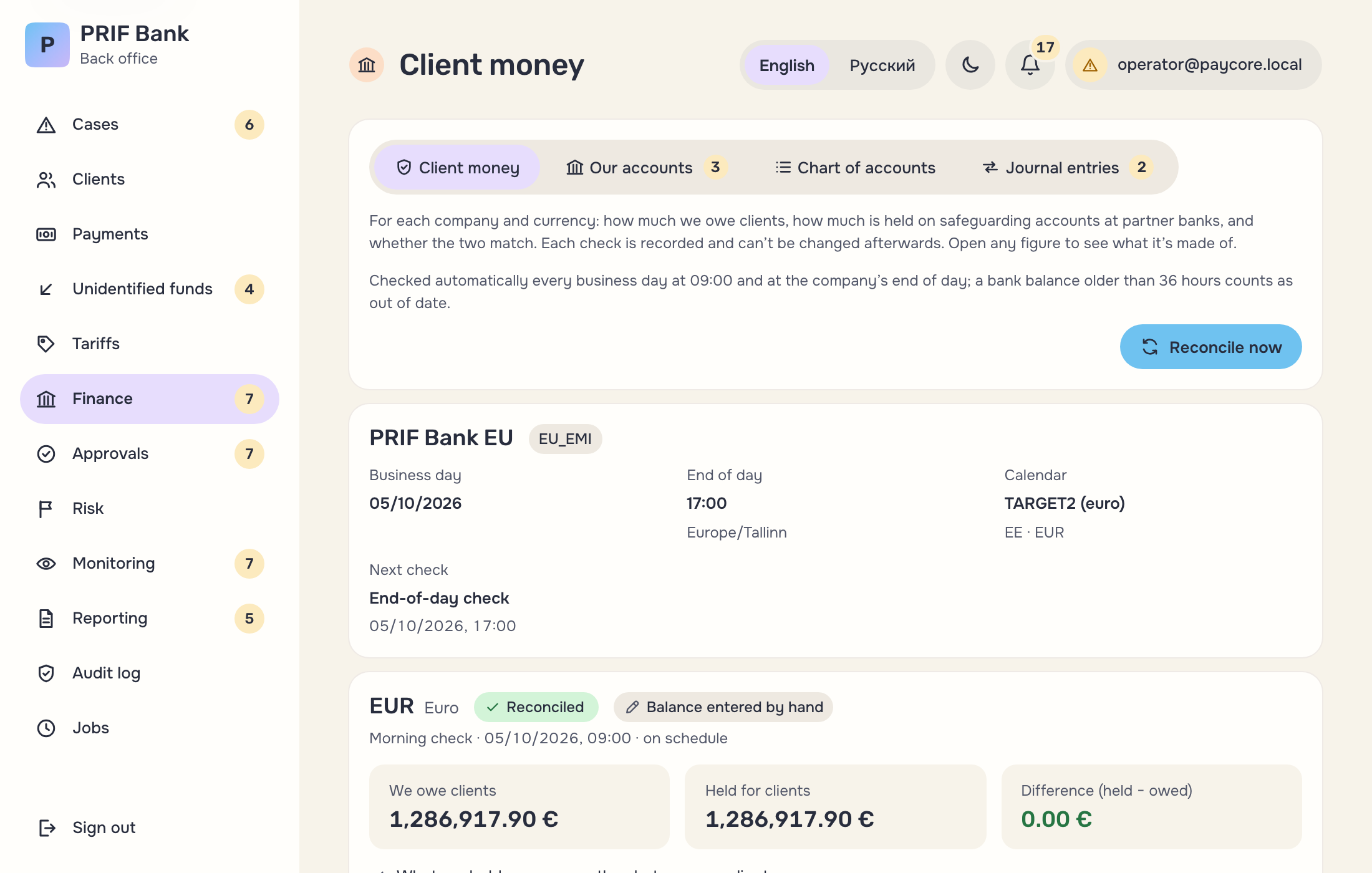
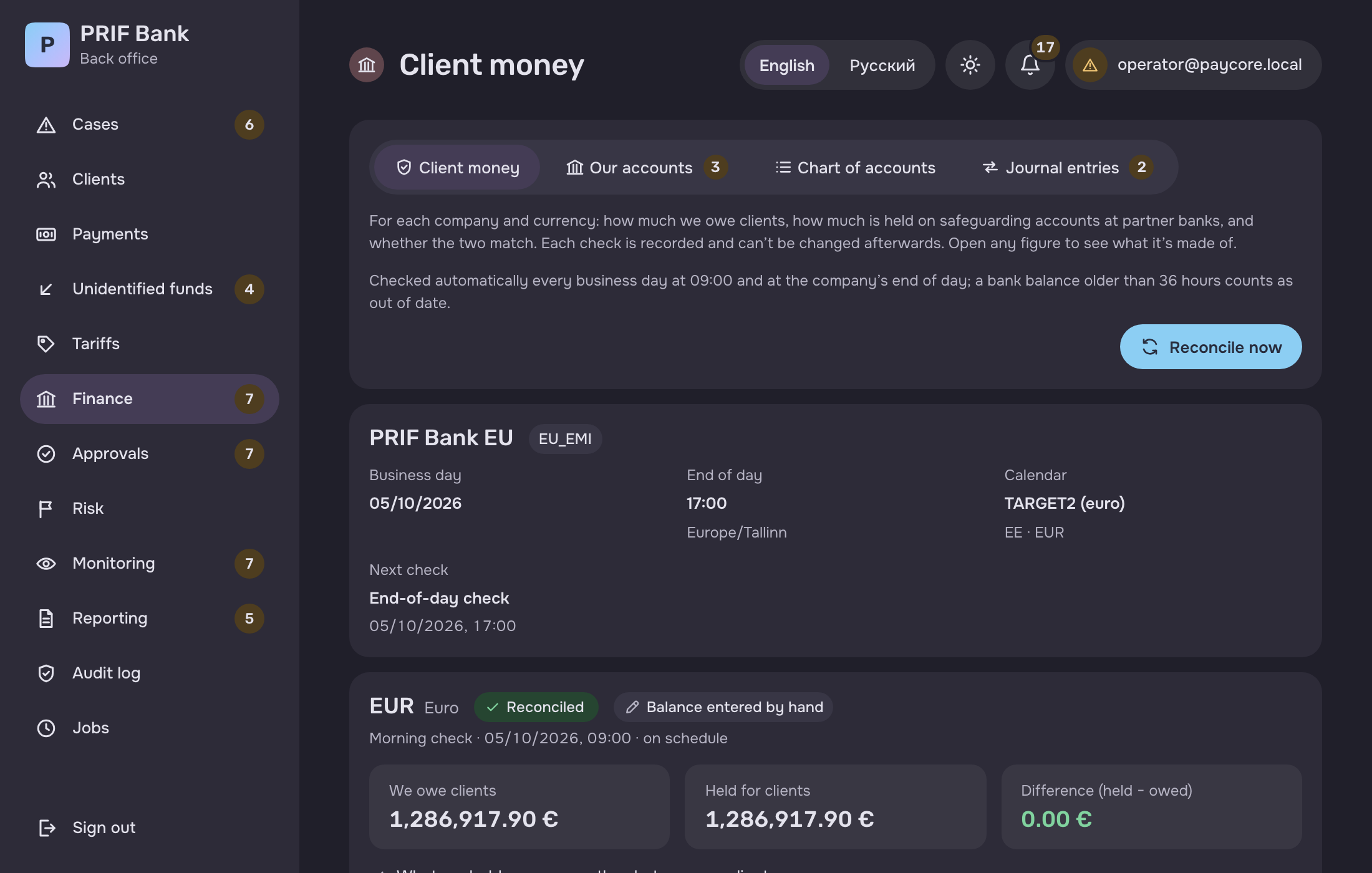
Back office of the demo, Finance: client money reconciled against the safeguarding account, difference 0.00. Test data.Back office of the demo, Finance: client money reconciled against the safeguarding account, difference 0.00. Test data.Back officeClient money reconciled

Three ways to work with us

Same software in all three; what changes is who holds the licence and who hosts.

Software licence

You take the software and run it yourself.

  • Currencies, tariffs, approval rules, risk weights: settings your team changes itself.
  • Languages are dictionary files in the build: English, Spanish, Russian today.
  • One Docker Compose file starts PostgreSQL, NestJS, Temporal, Blnk, Keycloak and Caddy.
Licence
Yours. Prifinance can obtain it (see Licensing).
Hosting
Your servers, or ours.
Regulator
You talk to it, with Prifinance as counsel.

Under a partner's licence (BaaS)

You bring the brand and the customers; everything regulated runs under a partner EMI's licence.

  • The partner EMI's compliance team takes the final decisions.
  • You cannot issue e-money in your own name.
Licence
The partner EMI's.
Hosting
Ours.
Start
After agent registration; the regulator has 2 months.

White-label

Web app, mobile app and back office under your name, domain and colours.

  • The brand lives in dictionaries, CSS tokens and a few components.
  • Web: light and dark themes; mobile app: Russian, dark theme today.
Licence
The partner EMI's, or your own.
Hosting
Ours or yours.
Brand work
Dictionaries, theme tokens, domain; we rebrand and translate during setup.

What runs on the platform today

The software behind the demo, as it runs today. Everything except the mobile app is visible once you sign in.

Customer web app and mobile app

English, Spanish and Russian; light and dark themes; sign-in through Keycloak.

  • Personal and company profiles switch in the header.
  • Mobile app on Expo: accounts, cards, payments, statements, company dossier.

Accounts, IBAN and statements

One account per currency with an IBAN; EUR, USD, GBP and CAD by default (a setting).

  • Statements for any period with turnover and fees; CSV and print.
  • Clients freeze their own account; unfreezing takes a one-time code.
  • Closing at zero balance is immediate; money left opens a compliance case.

Payments: SEPA today, SWIFT through providers

One transfer form; the software reads the IBAN and routes the payment.

  • To another client of yours: instant and, in the default tariff, free.
  • SEPA and SEPA Instant to any SEPA country; SWIFT through providers.
  • Verification of Payee, then a one-time code bound to amount and payee.

Virtual cards and FX

Virtual cards through a card-processor adapter; FX on ECB rates, cross-rates via EUR.

  • Online, contactless, ATM and magstripe switches; limits the client can only tighten.
  • Card details and PIN shown after a one-time code.
  • FX fee: the spread in basis points, 50 bp by default.

KYC and KYB

A dossier per client, a checklist by country and company type; your officer decides.

  • ClamAV scans every upload before anyone opens it.
  • One-time links: directors and beneficial owners verify without an account.
  • Companies House data for UK companies.

AML: screening, cases, monitoring, reports

Daily screening against sanctions, PEP and adverse-media lists (OpenSanctions or your own).

  • A hit opens a case; only the officer who took it decides.
  • 14-factor risk model; twelve monitoring rules run over each closed month.
  • SAR/STR drafts from the case file, EFTR candidates daily; submitted reports lock.

Back office with four eyes

Anything that moves money, and every tariff or approval rule, needs a second person.

  • Cases, client 360, payment approvals, unidentified funds on a 10-business-day clock.
  • Tariffs with fee bands and versions; approval rules up to five levels.
  • Hash-chained audit log, 17 re-timeable scheduled jobs, an inbox by role.

Bank accounting and safeguarding

Client money reconciled against safeguarding accounts, per entity and currency, morning and day close.

  • Each run is an uneditable record; a shortfall alerts finance and admins.
  • Register of partner-bank accounts with safeguarding letters; a 33-account chart.
  • Journal: one officer prepares, another signs. VAT and payroll stay external.

Payments and cards: who does what

Software does part of the job, providers do part, the licence covers the rest.

RailIn the softwareFrom the provider
SEPA (SCT and SCT Inst)Routing, pain.001, camt.054, Verification of Payee, one-time codes, holds, 04:30 statement check.Settlement account at a SEPA-reachable bank, EMI or CENTROlink; we introduce providers.
SWIFTRouter recognises non-SEPA destinations; we write the adapter to the provider's API.Correspondent access from our SWIFT providers, under a contract with you.
CardsIssuing, controls, limits, PAN and PIN after a one-time code, holds, fees.Card processor and BIN sponsor; we introduce the providers we partner with.
Identity checksDossier, checklist, virus-scanned documents, screening, the officer's decision.Optional: an automated identity-verification provider on the same adapter.

Provider fees are the provider's own, shown as they are.

Under the hood

For the CTO. The software is called PayCore; every fact below is in its repository at the pinned versions.

  • TypeScript monorepo (pnpm)
  • NestJS 10
  • Prisma 5
  • PostgreSQL 16
  • Temporal 1.32
  • Redpanda (Kafka API)
  • Blnk 0.15
  • Keycloak 26.8
  • Caddy 2.11
  • Next.js 15
  • Expo 54
  • versitygw (S3)
  • ClamAV

Ledger

  • Money is an integer in minor units, ISO 4217 code; no floats.
  • Every movement is a double-entry posting in self-hosted Blnk.
  • A 07:30 job proves the ledger sums to zero per currency.
Show detailsHide detailsfor Ledger
  • No float ever touches an amount; JSON carries amounts as strings. Floats exist only for ratios and coordinates.
  • Blnk is reached only through its API. Balances derive from postings and are never edited.
  • An outgoing payment is a hold first (inflight), then commit or void. Both are synchronous; if the response is lost, the retry reads the hold's state instead of posting twice.
  • The 07:30 job checks that, per currency, all ledger balances sum to exactly zero, that no unknown internal balance holds money, and that client money adds up the same two independent ways. It fixes nothing; it wakes people.

Payments

  • Each payment is a Temporal workflow: hold, submit, wait, commit or compensate.
  • After settlement there is no compensation; a human reviews.
  • ISO 20022: pain.001 out, camt.054 in; EPC list v8.0, mod-97.
Show detailsHide detailsfor Payments
  • The wait is bounded: 24 hours for a SEPA credit transfer, 30 seconds for SEPA Instant. A screening hook sits in the workflow and is a pass-through today; sanctions screening runs on clients, directors, beneficial owners and payees, and transaction AML rules open cases in the core.
  • After the partner reports settlement, the payment goes to manual review with an alert: reversing settled money is a human decision.
  • Workflow code changes go through Temporal's patched() marker, so a workflow that started on the old logic finishes on the old logic.
  • pain.001 with structured addresses and an EndToEndId that decodes back to our payment id; camt.054 parsing keyed on the bank's own reference, with DOCTYPE and files over 5 MB rejected. SEPA is EUR only, countries by the EPC list v8.0, IBAN length by country, mod-97.

Idempotency and events

  • Every call that moves money carries an Idempotency-Key scoped to the caller.
  • The domain write and its event commit in one database transaction.
  • Outbox to Redpanda: idempotent producer, acks=all, ordered per aggregate.
Show detailsHide detailsfor Idempotency and events
  • Transfers, FX, manual postings, reversals, journal entries, bank balances, unidentified-funds decisions and fee write-offs carry the key. It is scoped as u:<sub>:<key>, so a replay returns the caller's own earlier response and never anyone else's. Card controls, payees, tariffs and roles do not carry the key yet.
  • A relay publishes the outbox to Redpanda with an idempotent producer and acks=all, partitioned by aggregate. At-least-once by design, so consumers dedupe.
  • The relay reads the outbox in batches of 100 and keys each message by its aggregate (payment, client or account), so one payment's events land on one partition in order.

Identity and access

  • Keycloak 26.8, one realm, three clients; Authorization Code with PKCE S256.
  • Staff roles need a backoffice token, office IP and second factor.
  • One-time codes bound to sha256(amount|currency|payee), 5-minute TTL.
Show detailsHide detailsfor Identity and access
  • Clients web, mobile and backoffice. Password grants are off, brute-force protection is on, passwords are at least 12 characters.
  • The core accepts only RS256 access tokens from its own clients and reads roles from an explicit list. The mobile client carries no staff role at all.
  • Staff privileges exist only on a backoffice token, only from the office IP list, and only when the token's amr says a second factor was used. Fail any one of the three and the core strips the roles before the request reaches a handler.
  • Strong customer authentication with dynamic linking: 5 attempts, the code stored as an HMAC and encrypted with AES-256-GCM on its way to the notification service. The amount below which no code is asked is a setting; the demo runs it at 50.00 in the payment currency.

Integrity in the database

  • 32 database triggers, applied at every start.
  • Audit log rejects UPDATE, DELETE, TRUNCATE; each row hashes the previous.
  • Migrations only add: no DROP TABLE, no DROP COLUMN.
Show detailsHide detailsfor Integrity in the database
  • The triggers live in prisma/sql/extra.sql. Only the retention job may remove the oldest contiguous block of the audit log.
  • Each audit row stores sha256(previous hash + every field of the row). The back office recomputes the chain and names the row where it breaks.
  • Decided records stay decided: a submitted regulatory report, a reconciliation run, a bank balance entry, a signed journal entry. "You cannot sign your own request" and "a record is born pending" are CHECKs and triggers, not application code alone.
  • 23 migration folders (a baseline and 22 additive ones). The deployment script verifies the triggers on the live database before it reports success.

Edge and isolation

  • One door to the internet: Caddy 2.11, HSTS, strict CSP.
  • The back office: own hostname and container, admin IP list only.
  • Docker networks by role; the database network has no internet.
Show detailsHide detailsfor Edge and isolation
  • Caddy on 80/443 with Let's Encrypt; CSP with frame-ancestors 'none' and form-action limited to the site and Keycloak. Internal paths of the core (service APIs, partner callbacks) answer 404 from outside. Partner callback paths (SEPA status, card processor, identity provider) are closed today and open per contract, restricted to the partner's addresses, with a token per partner.
  • The same admin IP list gates staff operations on the API.
  • Networks edge, sso, internal, db, kcdb, ledger. Each service has its own database user, and CONNECT is revoked from PUBLIC. Node services run as UID 10001 without capabilities, with no-new-privileges, memory and PID limits; the code in the image is owned by root and the process cannot write to it.
  • Documents go to S3-compatible storage (versitygw today, the same client code for AWS S3) and through ClamAV on upload. A download needs a clean verdict; the public verification route refuses uploads while the scanner is down; a dossier file that arrived meanwhile stays locked until it is uploaded again (finance documents can be rescanned). PDF, JPEG and PNG by content, 15 MB cap, no direct links.

Delivery and tests

  • About 2,000 automated tests in the core, about 2,400 across the repository.
  • Deploy order: tests, images, full backup, additive migrations, live database checks.
  • Hourly encrypted backups of core and ledger; a restore drill script.
Show detailsHide detailsfor Delivery and tests
  • Every business rule is a pure function in a *.domain.ts file with its test next to it: tariff changes, case assignment, journal approval, unidentified-funds resolution, hold expiry.
  • Tests run as a Docker build stage. If they fail, the script reports "nothing was changed".
  • At NODE_ENV=production the core refuses to start with development passwords, an HTTP identity provider, a simulated rail, fake KYC, fixed FX rates or a disabled scheduler.
  • One hourly run dumps the core and ledger databases together, so the two never drift apart by more than the dump takes; a nightly run covers everything plus documents. gpg (AES-256) encrypts the dumps, rclone crypt the documents copy. The runbook keeps the drill log.

Errors and languages by code

  • The core returns a code and parameters; the site renders the text.
  • 245 error codes, each in the user's language.
  • 55 namespaces, more than 3,700 keys; the build stops on any mismatch.
Show detailsHide detailsfor Errors and languages by code
  • Every language must have the same keys, the same ICU arguments and plural forms and the same tags, or the build stops. A new error code goes into the English dictionary first; the build fails until the other languages have it too.
  • Parameters that travel with a code are strings and numbers only. The site drops anything else, strips control characters and cuts each value at 80 characters before it reaches a template.

Not in the software today

Things we get asked about; better read here than found in the demo.

  • Production SWIFT adapter: type and routing exist; we write it per provider.
  • UK Faster Payments, Interac, EFT: recognised in routing, no rail behind them.
  • Per-payment screening at send time: the workflow hook passes everything today.
Show detailsHide detailsfor Not in the software today
  • Physical card issuing: a fee type exists, the flow does not.
  • camt.053 import and line-by-line reconciliation of the bank's own accounts: finance enters bank balances by hand, with the statement file and a second signature.
  • Passkeys and push notifications.

Built for compliance officers who check

  • Four eyes on every money movement and every pricing or approval rule.
  • The officer who took a case decides it; nobody takes it over.
  • Tipping-off safe: no client-side path to a report; submitted reports are immutable.
Show detailsHide detailsfor Built for compliance officers who check
  • The database compares author and signer by identity. Under four eyes: manual postings, reversals, unidentified funds, tariffs, approval rules, journal entries, partner accounts, bank balances, fee write-offs, high-risk decisions, unfreezing a high-risk client.
  • Every sensitive action lands in the audit log in the same transaction as the change, with IP, country, device and the before and after state, kept for 5 years.
  • Screening covers clients, directors, beneficial owners, payees and the senders of unidentified funds, daily. AML rules open cases; they do not block silently.
  • Compliance roles export regulatory CSVs (payments, large transactions, clients), and the log records each export.

The licence, handled by Prifinance

Prifinance is a law firm, not a licence broker. Lawyers who have filed these applications write the file; fees are fixed and itemised before you start.

Under a partner's licence (a "sub-licence" in everyday speech)

A licensed EMI registers you as its agent; you distribute and redeem e-money under its licence.

  • UK: EMD or PSD agent; the principal files with the FCA.
  • EU: agent (PSD2 Art. 19) or e-money distributor (EMD2 Art. 3(4)).
  • No own capital or safeguarding; decision in 2 months (PSD2 Art. 19(2)).
Best for
a fast launch, or a product that does not need to issue e-money in its own name.

Your own licence

Prifinance writes the file: programme of operations, safeguarding, own funds, AML/CFT policies, IT and DORA, governance, wind-down plan.

  • Capital: EMI EUR 350,000 (EMD2 Art. 4); PI EUR 20,000 to 125,000.
  • A UK small EMI: up to EUR 5 million average outstanding e-money.
  • No UK passport into the EEA since 2021: EU entity needed.
Best for
issuing e-money in your own name, EEA passporting, your own safeguarding accounts.

Where we obtain licences and registrations

JurisdictionRegulator and licenceStatutory clockRealistic end-to-endNotes
United KingdomFCA: authorised or small EMI, authorised or small PI; EMD and PSD agents3 months from a complete file, up to 12 if incomplete (EMRs 2011 reg. 9)6-12 monthsNo EU passport. For actual durations the FCA publishes quarterly service metrics: lower quartile, median and upper quartile in days per application category.
LithuaniaBank of Lithuania: EMI, restricted EMI, PI3 months from a complete file; 2 for a restricted EMI; completeness check in 5 business days6-12 monthsCENTROlink: direct SEPA access for EEA-licensed EMIs and PIs.
CanadaBank of Canada RPAA registration and FINTRAC money services business (MSB) registration; Quebec MSB licenceNo published clock; FINTRAC review 3-6 weeks (Mondaq)4-8 months for the full stackRegistration, not a licence. RPAA supervision since September 2025.
IrelandCentral Bank of Ireland: EMI, PI90 business days for 90% of files once assessment starts; the clock pauses on questions12-18 monthsEU passport; English-language regulator.
NetherlandsDNB: EMI, PI3 months from complete information6-9 monthsFiling fee EUR 10,400.
MaltaMFSA: financial institution (EMI, PI)PSD2 Art. 12 as transposed: 3 months from a complete file9-15 monthsEU passport; English-language files.
CyprusCentral Bank of Cyprus: EMI, PI3 months from a complete file; pre-application stage with a EUR 5,000 fee from 3 August 20269-15 monthsEU passport.
EstoniaFinantsinspektsioon: EMI, PI3 months after all documents, at most 6 from filing; portal-only filing since 18 March 20268-14 monthsFully digital filing.
Show all 22 jurisdictionsShow the main 8
JurisdictionRegulator and licenceStatutory clockRealistic end-to-endNotes
LuxembourgCSSF: EMI, PINo fixed clock published; CSSF data 2020-22 on all authorisations: 66% within 6 months12-18 monthsEU passport.
LatviaLatvijas Banka: EMI, PIPSD2 Art. 12: 3 months from a complete file8-14 monthsFiling fee EUR 5,000; EUR 450 for innovative services.
PolandKNF: KIP (PI), KIPE (EMI)PSD2 Art. 12: 3 months from a complete file9-15 monthsEU passport.
Czech RepublicCNB: EMI, PIPSD2 Art. 12: 3 months from a complete file8-14 monthsEU passport.
SpainBanco de España: EMI (Ley 21/2011), PI3 months; silence counts as refusal12-18 monthsEU passport.
GermanyBaFin: EMI, PI (ZAG)3 months from a complete file (§10(3) ZAG for a PI; §11(2) ZAG applies it to an EMI); refusal if still incomplete after 12 months12-18 monthsEU passport.
FranceACPR: EMI, PI3 months from a complete file (PSD2 Art. 12 as transposed); ACPR fintech charter: feedback within 3 weeks of filing6-9 monthsNo filing fee.
SwedenFinansinspektionen: EMI, PI3 months with a complete file and the fee paid (SEK 405,000)6-12 monthsEU passport.
United StatesFinCEN MSB registration plus state money-transmitter licences (49 states and DC)FinCEN: register within 180 days of starting, no approval step; each state runs its own clock12-24 months to multi-state coverageNo federal EMI licence exists.
SingaporeMAS: standard or major payment institution (SPI, MPI)No statutory clock; MAS may hold a file for up to 6 months9-15 months (MPI)English-language regulator.
Hong KongC&ED: money service operator (MSO); HKMA: stored value facility (SVF)MSO: 33 working days on a complete file (Mondaq)MSO 3-6 months; SVF 9-15 monthsSVF capital HKD 25 million.
UAECBUAE retail payment services; ADGM FSRA; DIFC DFSA money servicesNo published clock6-12 months (CBUAE)Three regulators, three rulebooks.
SwitzerlandFINMA fintech licence (Art. 1b Banking Act); SRO affiliationFINMA publishes no clockSRO route: weeks to monthsNo EMI licence as such. Fintech licence capital CHF 300,000.
AustraliaAUSTRAC remittance registration; ASIC AFSLAUSTRAC: up to 90 days; the clock resets on information requestsOn requestRegistration lasts 3 years.

Statutory clocks run from a complete file. Realistic figures are Prifinance planning estimates. Fees are fixed and itemised; state, supervisory and audit fees appear as separate lines.

Case

Montify: a UK EMI, from idea to first payment

We launched Montify from zero. Companies House shows Montify Ltd incorporated on 27 September 2019; the FCA authorised it as an electronic money institution in 2020. It still runs: payment accounts, multi-currency, cards, FX.

montify.com, opens in a new tab

How it works

  1. Step 1

    Free project analysis

    You tell us the markets, rails and whether you want your own licence. Within 2-5 business days: a written assessment with route, capital, timeline and fees.

  2. Step 2

    Company and licence

    Own licence: company, capital, directors and compliance officer, then the file and the regulator's questions. Agent route: the partner EMI files your registration.

  3. Step 3

    Your brand on the platform

    In parallel with step 2: dictionaries and theme, currencies, tariffs, approval rules, provider accounts, staff roles. Your people start on demo data.

  4. Step 4

    Launch and after

    We stand next to you for the first real payment, set the reporting calendar, switch on the scheduled jobs, run the first restore drill, and stay on support.

Pricing

Three lines from three parties, each itemised. The numbers come in the proposal, within one business day.

Platform

Setup plus a monthly fee: software, updates, hosting if we host, support. Self-hosting and white-label are separate lines in the same proposal.

Licence

Fixed legal fees, itemised before you sign. State, supervisory and audit fees are separate lines at the regulator's rates; agent route and full application are quoted separately.

Providers

SEPA, SWIFT and card fees are the providers' own. Under your own licence the provider contract is yours; under a partner's, the principal holds it and fees pass through.

Questions buyers ask

Do I need my own licence to start?

No. A licensed partner EMI registers you as its agent; you cannot issue e-money or call yourself licensed. The documents you build as an agent later become most of your own application file.

How long does a licence take, and when does the clock start?

The statutory clock in the EU and the UK is 3 months; it starts when the regulator deems the file complete. Realistic figures per jurisdiction are in the table, as planning estimates.

Are KYC and AML included?

Yes, as software: dossiers, checklists, sanctions and PEP screening, risk scoring, monthly monitoring, cases, SAR/STR/EFTR drafts. Your compliance officer decides; an identity-verification provider plugs into the existing adapter.

How are SEPA, SWIFT and cards connected?

SEPA is in the software and runs through our SEPA providers or CENTROlink. SWIFT goes through our SWIFT providers; we write the adapter per provider. Cards: a processor we partner with. Names and fees come in the proposal.

What about safeguarding?

Reconciliation of client money against safeguarding accounts runs morning and day close; every run is immutable. Accounts open at a bank or via the partner EMI. UK: CASS 15 from 7 May 2026, daily reconciliation, annual audit.

Where does the software run, and who owns the data?

Under a software licence it can run on your servers; then PostgreSQL, the Blnk ledger and the S3 bucket are yours. Under BaaS or white-label we host it; exports on request, within the partner EMI's obligations.

Can my team change the software?

Everything operational is a setting: currencies, tariffs, approval rules, risk weights, chart of accounts, job schedules. Dictionaries and themes change at build time. Changing the code depends on the licence terms; say what you need, we put it in writing.

Is PRIFBANK a bank?

No. PRIFBANK by Prifinance is B2B software and legal services. The demo at app.prifbank.com runs the software on test data and holds no client money. Regulators grant licences to you or to the partner EMI, never to the software.

Get a proposal

Write to us with the route, the markets and rails, whether you already hold a licence, and your website. We reply within one business day; for your own licence a written assessment follows within 2-5 business days.

Väike-Paala tn 1, Tallinn, Estonia · prifinance.com